
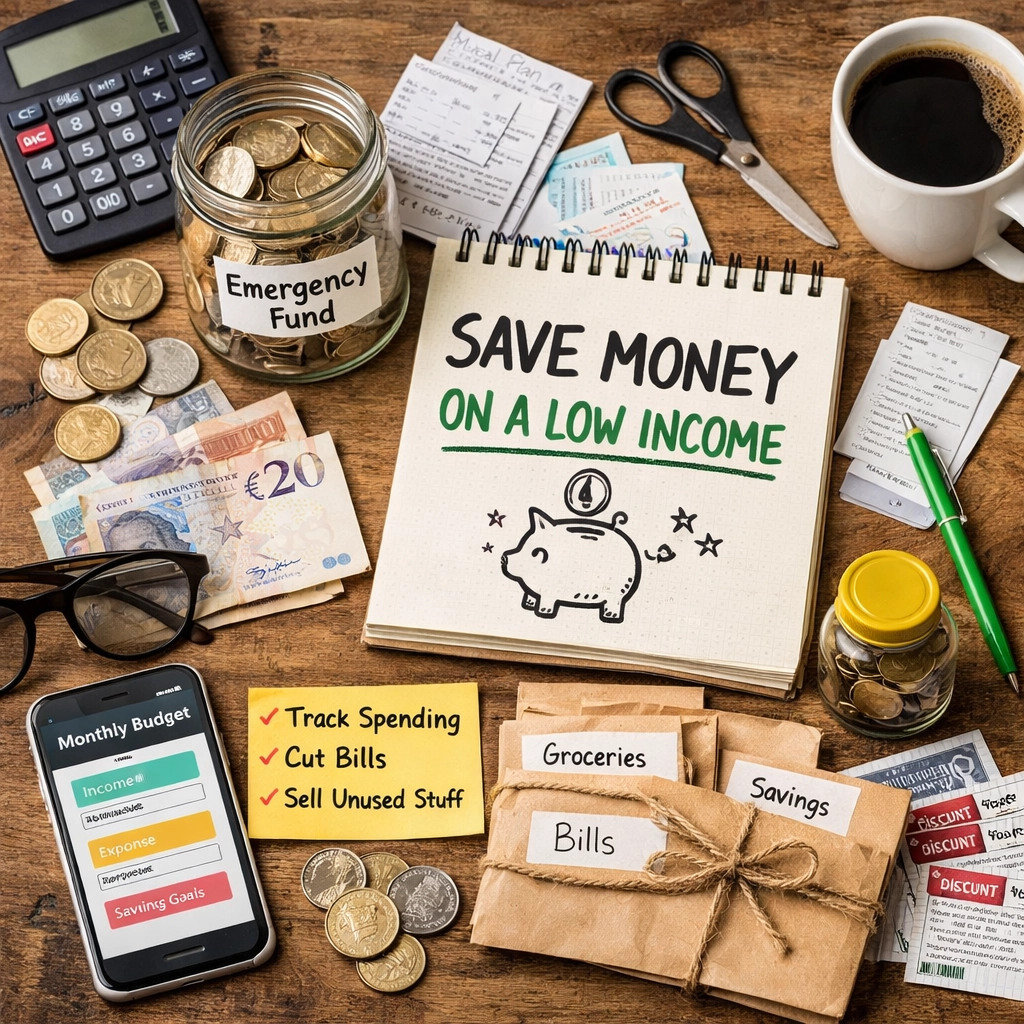
If your money disappears before payday, you are not alone. When income is limited and essential costs are high, saving can feel impossible. A useful plan does not begin with guilt or extreme cutbacks. It begins with knowing what must be paid, checking whether more support is available and choosing one change you can repeat.
This guide is written for readers in Ireland and the UK. Costs, benefits, taxes and financial products differ between the two countries, so you will find separate local resources as well as examples in euros and pounds.
Before you start saving: protect the essentials
A savings challenge is not the right first step for everyone. Begin by writing down the money already received and the costs due before the next payday. Protect housing, utilities, food, essential transport, childcare, necessary medical costs and minimum debt payments.
Check what is actually available
Use your take-home pay after tax, National Insurance or PRSI and other deductions. If income varies, plan from the lowest dependable amount rather than your best month.
Check support before making cuts
Benefits, social welfare, grants, reduced tariffs or tax credits may improve your position more than cancelling another small comfort.
Prioritise high-consequence bills
Some missed payments have more serious consequences than others. Free money advisers can help you order debts and negotiate affordable arrangements.
Choose a small first target
Try £50 or €50, then one essential bill, then £250 or €250. A staged buffer is more achievable than aiming immediately for several months of expenses.
15 realistic ways to save money on a low income
Review three months of real spending
Look at bank, card and cash spending from the last three months. Group transactions into essentials, flexible needs, enjoyment and avoidable costs. Three months is more useful than one because it catches less frequent payments and unusual weeks.
Do not search for dozens of tiny mistakes. Circle the two or three costs that are both adjustable and large enough to matter—perhaps an unused membership, frequent delivery charges or a tariff that has not been reviewed. Use the interactive budget planner to organise the figures.
Build a budget around essential costs
The popular 50/30/20 budget is not realistic for every low-income household. Rent, childcare, food and energy may already take far more than 50% of income. Instead, fund essentials first, allow a realistic amount for flexible spending and decide what—if anything—can safely go towards savings or debt.
If income changes, budget from money already received or a conservative baseline. Our beginner budgeting guide explains the process step by step.
If you live in Ireland, use our realistic Cost of Living in Ireland 2026 household-budget guide to review housing, energy, food, transport and other essential costs using your household’s actual bills.
Automate only an affordable amount
An automatic transfer can remove the need to make the same decision every week. If it is safe, schedule £5 or €5 shortly after payday. That would add up to £260 or €260 over 52 weeks before interest. Even £1 or €1 is a legitimate beginning.
Check the account first and pause the transfer during a difficult month. Saving should not trigger overdraft fees, returned payments or missed essentials. Increase the amount only after it has felt manageable for several pay cycles.
Cancel, pause or renegotiate invisible costs
Search statements for subscriptions, app renewals, account fees, memberships and insurance add-ons. Cancel what you no longer value, but do not remove something genuinely useful merely because it is labelled non-essential.
For services you want to keep, check whether a lower tier, annual rate, family plan or retention offer is cheaper. Record renewal dates so you can compare prices before automatic renewal. One £8 or €9 monthly saving is worth £96 or €108 across a year.
Try a focused no-spend period
Choose one optional category—not all spending—and pause it for seven days. Examples include takeaway coffee, new clothing, paid entertainment or online impulse purchases. Decide in advance what is allowed so the challenge does not interfere with food, health, work or family needs.
Move the amount you genuinely avoided spending into a separate pot. A short, specific experiment is usually easier to sustain than an open-ended ban and helps reveal which purchases you miss and which you do not.
Plan meals from food you already have
Check cupboards, fridge and freezer before planning three to five familiar meals. Write one list, compare unit prices and keep one flexible meal for leftovers. This reduces duplicate purchases, food waste and last-minute takeaways without requiring a complicated weekly menu.
Batch-cook only foods your household will actually eat and freeze suitable portions promptly. The meal-planning and batch-cooking guide provides a practical 3–2–1 system.
Give flexible spending a weekly limit
A monthly allowance can be hard to judge, especially in a five-week month. Divide money for groceries, transport top-ups, socialising and personal spending into weekly amounts. Use cash envelopes, separate bank pots or a simple note—whichever helps you see what remains.
Cash can improve awareness, but it is not automatically cheaper and may be inconvenient for online bills. The useful principle is separation: protect money for upcoming commitments before spending from flexible categories.
Add a pause before non-essential purchases
Use a 24- or 48-hour waiting period for unplanned, non-essential purchases. Save the item rather than buying immediately, check whether you own a suitable alternative and consider borrowing or buying second-hand.
For larger purchases, compare the total cost—including delivery, subscriptions, accessories and finance charges—not just the headline price. A pause is not about denying every enjoyable purchase; it gives you time to decide whether it is worth the trade-off.
Reduce household bills safely
Review energy, broadband, mobile, insurance and banking costs at renewal. Compare the full contract, exit fees, service quality and introductory-rate end date. If switching is not suitable, ask the current provider whether a cheaper tariff is available.
Low-cost changes such as reducing unnecessary standby use, washing full loads and avoiding wasted hot water may help, but do not compromise adequate heating, lighting, food storage or health. Eligible UK households should check social tariffs; Irish households can review current cost-of-living supports through Citizens Information.
Compare unit prices and use own-brand swaps selectively
Supermarket own-brand products can cost less, but compare the price per kilogram, litre or item because the cheapest pack is not always the best value. Test one or two swaps at a time in products where brand matters least to you.
Use loyalty offers only for planned purchases and compare the final price elsewhere. A discount does not save money if it encourages you to buy more than you need or replace an affordable choice with a premium one.
Sell unused items without counting the money twice
Clothes, small furniture, electronics, books and equipment may produce a one-off boost. Check recent sold prices, photograph items clearly, describe faults honestly and account for platform fees, postage and travel.
Send the net proceeds directly to your chosen buffer or overdue essential cost. Treat sales as temporary income rather than a permanent solution, and never pay unexpected “release” or courier fees requested by a supposed buyer.
Use staged micro-goals
“Save more” is difficult to measure. Choose a small amount and a reason: £50 or €50 for an urgent buffer, £120 or €120 for an annual bill, or one week of groceries. Display progress as ten smaller steps rather than one intimidating total.
After reaching the first goal, create a sinking fund for a predictable cost such as insurance, school expenses, Christmas or car maintenance. Planning for known costs reduces the chance that they become expensive emergencies.
Decide in advance what happens to extra income
If overtime, a refund, gift or higher-income month arrives, choose a percentage for urgent needs, upcoming bills, debt, savings and enjoyment before the money is absorbed into everyday spending. The split should reflect your circumstances rather than a rigid rule.
Someone with arrears may need to protect priority payments first; someone with stable bills may add more to a buffer. Allowing a small amount for enjoyment can also make the plan easier to maintain.
Use discounts and cashback carefully
Discount codes, loyalty points and cashback can reduce the price of something already planned. Compare the ordinary price first, check minimum-spend conditions and avoid carrying a credit-card balance for rewards because interest can easily exceed the benefit.
Withdraw cashback to savings rather than leaving it forgotten in an account. Treat rewards as a small extra, never as a reason to purchase something outside your budget.
Run a 15-minute weekly money reset
Once a week, check balances, recent transactions, bills due and available money until the next payday. Correct errors, move money between categories when plans change and choose one action for the coming week.
A short review prevents surprises without turning money management into a daily source of stress. Use the weekly money reset checklist and complete a deeper review once a month.
A realistic 30-day low-income saving plan
This illustration shows how several modest actions could create an initial buffer. Your costs and results will differ, and none of these savings is guaranteed.
| Possible action | UK example | Ireland example |
|---|---|---|
| Cancel one unused subscription | £8 | €9 |
| Replace one planned takeaway with food already available | £18 | €20 |
| Reduce food waste through meal planning | £20 | €20 |
| Sell one unused item after fees | £25 | €25 |
| Save £5/€5 each week | £20 | €20 |
| Illustrative first-month total | £91 | €94 |
Ways to improve your position on a low income in Ireland
Before making severe cuts, check whether you are receiving the supports for which you may qualify. Eligibility and payment rates change, so use official sources rather than relying on old social-media posts.
Use MABS
The Money Advice and Budgeting Service provides free, confidential and independent support with budgeting and problem debt. See MABS guidance for living on a low income .
Check social welfare and cost-of-living support
Citizens Information explains current supports, eligibility and application routes. MyWelfare may also provide relevant online services.
Ask about urgent essential costs
An Additional Needs Payment may help with certain essential expenses that a household cannot meet from weekly income or other resources. It is means-tested and decided case by case; check current official rules before applying.
Review safe savings options
Compare access, interest, fees and deposit protection before opening an account. A local credit union may suit some savers, but product terms and eligibility vary. Do not lock away money needed for near-term bills.
Ways to improve your position on a low income in the UK
Support varies across England, Scotland, Wales and Northern Ireland. Check the rules that apply where you live and verify schemes through government or recognised free-advice services.
Check your entitlement
MoneyHelper provides guidance on benefits, grants, bills and income changes. GOV.UK also lists approved benefits calculators.
Consider Help to Save if eligible
The government-backed Help to Save scheme is available only to eligible people receiving certain benefits. Check the current qualification, bonus and withdrawal rules directly on GOV.UK.
Look for social tariffs and local help
Some broadband and other essential services offer lower-cost tariffs for eligible benefit recipients. Emergency welfare support varies by nation and local authority, so use official local information.
Get free debt help early
MoneyHelper can direct you to free services. StepChange also provides free information on increasing income, budgeting and dealing with debt.
How to save money with an irregular income
Base essential commitments on the lowest dependable month or on money already received. Calculate the minimum needed for housing, utilities, food, transport, childcare, medical needs and debt payments. Keep business money, tax and personal spending separate where relevant.
- Build a one-month calendar of due dates.
- Create a baseline budget for essential costs.
- During a higher-income month, fund the next low-income period first.
- Set aside money for tax if it is not deducted automatically.
- Split any genuine surplus between upcoming bills, a buffer, debt and flexible spending.
For predictable annual costs, use the guide to budgeting for irregular expenses .
What if there is nothing left to save?
Sometimes careful budgeting cannot create a surplus because income is genuinely below essential costs. That is not a failure of discipline. Pause savings goals and focus on stabilising cash flow.
- Check benefits, social welfare, grants and reduced tariffs.
- Contact providers before a missed payment where possible.
- Use free qualified debt advice instead of fee-charging debt-management services.
- Check payslips, tax codes, PRSI or National Insurance deductions and employment entitlements.
- Avoid high-cost short-term borrowing to create the appearance of savings.
The immediate goal may be preventing a new arrear, feeding the household or keeping the lights on—not adding money to a savings account. Return to saving when essential finances are stable enough to support it.
Free Lifestyle Hub Today money tools and guides
Saving money on a low income: FAQs
How can I save money quickly on a low income?
Begin with recent statements, protect essential payments and identify one or two adjustable costs. If affordable, move a small amount such as £5 or €5 into a separate pot. Checking benefits, social welfare and reduced tariffs may improve cash flow more than extreme cutbacks.
How much should I save each month on a low income?
There is no responsible universal percentage. Save only what remains after essential costs and minimum debt payments. That might be £1/€1, £20/€20 or nothing during a difficult month. A small repeatable amount is better than a target that causes fees or missed bills.
Should I save while I have debt?
It depends on the debt, interest rate, arrears and your need for an emergency buffer. Priority bills and high-cost debts may require attention first, while a small buffer can prevent further borrowing. Seek free personalised guidance from MABS in Ireland or a free debt-advice service through MoneyHelper in the UK.
What is a good first emergency-fund target?
Start with a staged target such as £50 or €50, then the value of one essential bill and later £250 or €250. Over time, you may work towards one month of essential expenses where affordable. The right target reflects your income stability and household needs.
What if my income changes every month?
Plan from the lowest dependable income or money already received. Protect essential costs and tax first. In a stronger month, prepare for the next low-income period and upcoming annual bills before increasing flexible spending.
Can I save money without cutting all enjoyment?
Yes. Focus first on waste, unused services, expensive fees and purchases that matter least to you. Keep a modest amount for enjoyment where possible; a humane plan is more likely to last than an unnecessarily restrictive one.
Sources and editorial approach
The Lifestyle Hub Today Editorial Team reviewed practical budgeting guidance and official support information for Ireland and the UK. Product eligibility, benefits and support schemes can change; always check the linked official source before acting.
- MABS: Living on a Low Income
- Citizens Information: Help with the Cost of Living
- MoneyHelper: Living on a Squeezed Income
- GOV.UK: Help to Save
- StepChange: Saving Money and Increasing Income
Editorial review date: 21 August 2026. Suggested next review: February 2027, or sooner if a linked scheme changes.
Help someone build a calmer money plan
Share these realistic Ireland and UK saving tips with someone who may find them useful.
Important: This guide provides general educational information and is not personalised financial, debt, tax or investment advice. Rules and eligibility vary. If you are struggling to meet essential payments, contact a free qualified advice service as early as possible.
